

RSV Vaccine Update
As the winter viral respiratory disease season approaches, COVID has been stealing most of the attention with the havoc it has caused over the last four years, the concern of another surge with new variants on the horizon and a new vaccine available now. There is, however, another virus out there that is the one of the most common causes of childhood illness and hospitalization as well as the cause of up to 177,000 hospitalizations and 18,500 deaths annually in adults over 651,2. And we now have some new ways to protect both adults and children just approved by the FDA and ACIP from this villain.
Respiratory syncytial virus is an RNA respiratory virus that causes a wave of infection every winter in adults and children. In infants, it is the main cause of bronchiolitis, a leading cause of hospitalization3. In adults it can cause upper and lower respiratory infections that can induce exacerbations of underlying illnesses leading to hospitalization and death. No treatment is available beyond supportive care for the disease when present, so prevention is critical to avoid this problem.
RSV Vaccines for Adults
Two RSV vaccines for adults have been recently approved, Arexvy (GSK) and Abrysvo (Pfizer). These vaccines are for adults age > 60. Abrysvo also has the added indication for use in pregnancy between weeks 32 and 36 of gestation to provide passive immunity for the future newborn. Both vaccines are single injections and have side effect profile similar to other vaccinations, although Arexvy may be associated with more injection site reactions.
The CDC recommends discussing the vaccination with patients who are at risk for severe respiratory infections including patients with chronic lung, heart or neurologic disease, diabetes mellitus, liver, kidney or blood diseases, immune compromise, frailty, and residence in a congregate setting3. The decision to give the vaccine should be made based on discussion by patient and provider. So far only one vaccination is recommended but that may be updated with time. The efficacy against lower respiratory tract infections varied from 82.6 to 66.7% depending on virus subtype and vaccine used, with Arexvy perhaps being more effective based on current data4,5. A recent modeling study suggested that a vaccine such as these may be able to prevent up to two million cases a year if 60% of the population is vaccinated along with 690,000 cases prevented in the unvaccinated due to reduced infection sources6. [See table below.]
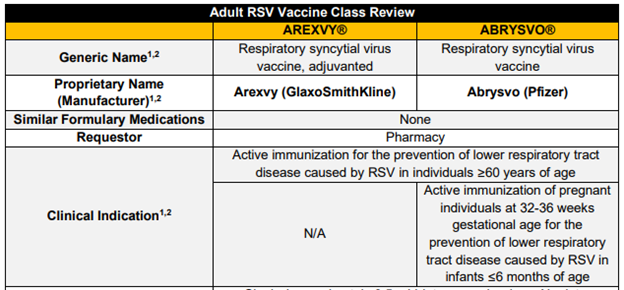
RSV vaccinations are similar to Shingrix zoster vaccination as they are covered by Part D but not by Part B of Medicare. Private insurance will eventually cover this vaccination but unfortunately they have a year to onboard it. Patients should check about coverage as the vaccine cost about $250. Valley will not be offering the RSV vaccines for adults at our clinics, and is recommending patients be referred to local pharmacies.
RSV Vaccines for Children
Beyfortus was approved on September 6, a monoclonal antibody against the RSV fusion protein that provides passive immunity to infants in their first (normal immunity) and second years (if compromised) during the RSV season7. Unlike a similar currently available protective monoclonal named Synagis, this medication needs to be injected only once in a RSV season, instead of monthly, making it much easier to use. It’s pending acceptance by the Vaccines for Children program (VFC) and it should be economical to use. Timing is a bit tricky because it should only be given to at-risk children during the RSV season from October through March. Valley will soon be offering this vaccine for children in the hospital and primary care clinics.
As COVID becomes a less aggressive virus due to general immunity and viral mutation, other respiratory viruses once again will lead the way on respiratory infection morbidity and mortality. Along with flu and COVID vaccination, the new RSV vaccinations and monoclonals may help you to keep your patients even safer this winter. Here is the Beyfortus flyer.
References
- Matias G et al “Estimates of hospitalization attributable to influenza and RSV in the US during 1997-2009”, BMC Public Health, 17:271 2017
- Hansen CL et al “Mortality associated with influenza and respiratory syncytial virus in the UW 1999-2018”, JAMA Netw Open, 5 e220527
- CDC “Respiratory syncytial virus infection” August 4, 2023
- Papi A et al “Respiratory syncytial virus prefusion protein F vaccine in older adults”, NEJM 388:595 2023
- Walsh EE “Efficacy and safety of a bivalent RSF prefusion vaccine in older adults” NEJM 388:1465, 2023
- Van Effleterre, T “Modeling respiratory syncytial virus adult vaccination in the United States with a dynamic transmission model” Clinical Infectious Diseases 77:480, 2023
- Simoes, EAF “Efficacy of nirsevimab against respiratory syncytial virus lower respiratory tract infections in preterm infants and pharmacokinetic extrapolation to infants with congenital heart disease and chronic lung disease, a pooled analysis of randomized controlled trials” Lancet child adolesc health, 7:180, 2023